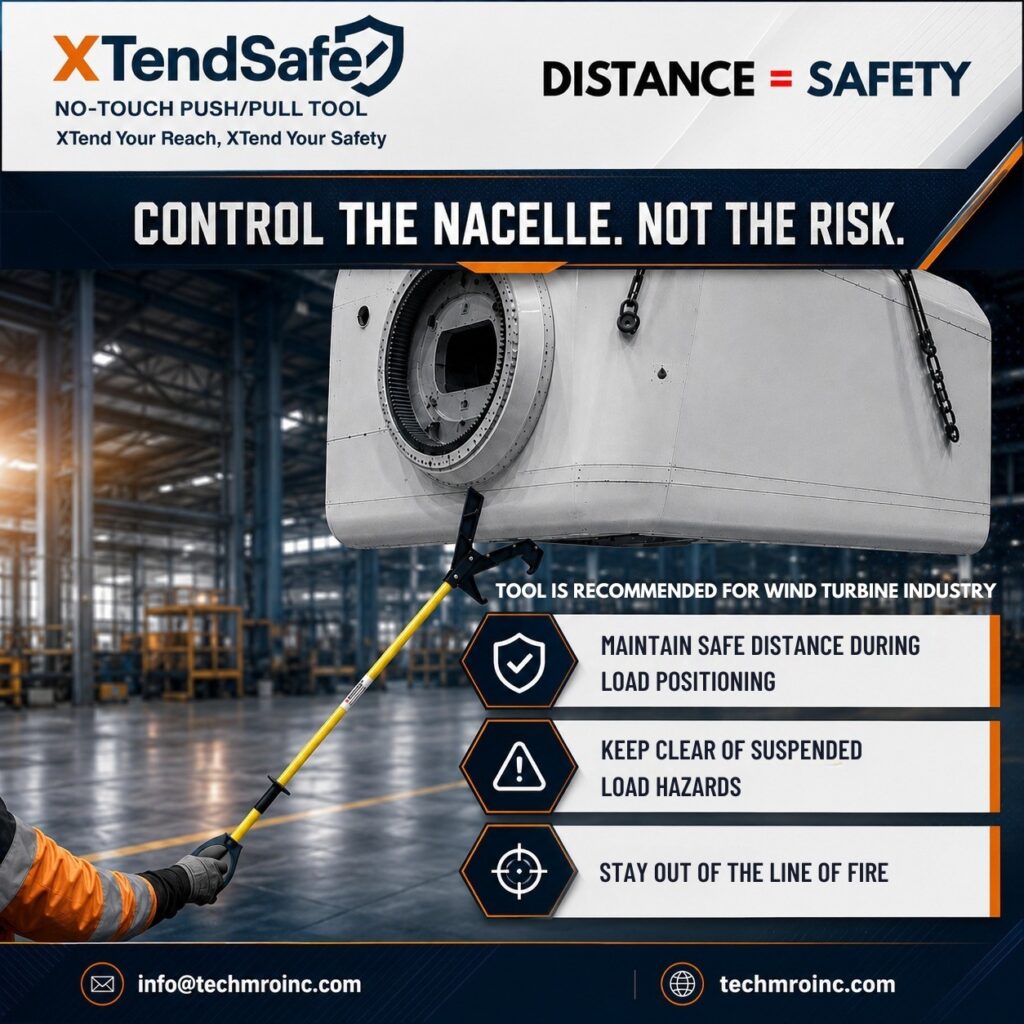
Safe Distance During Load Positioning: How to Reduce Suspended Load Hazards and Line-of-Fire Risks
Learn how Safe Distance During Load Positioning helps reduce suspended load hazards, line-of-fire risks, pinch points, crush zones, and hand injuries during lifting and rigging operations.
Introduction
In lifting and rigging operations, the greatest risk is often not during the lift itself but during the final stages of load positioning.
Loads are lifted successfully every day in wind energy facilities, power plants, refineries, ports, manufacturing plants, construction projects, and heavy industrial environments. However, many serious incidents occur when workers move closer to the suspended load to guide, align, rotate, stabilize, or seat it into its final position.
This is where the principle of Safe Distance During Load Positioning becomes critical.
Maintaining Safe Distance During Load Positioning helps reduce worker exposure to suspended load hazards, pinch points, crush zones, and line-of-fire risks. Instead of relying solely on awareness, training, or personal protective equipment, this approach focuses on physically separating workers from hazardous load movement.
As organizations continue to prioritize exposure reduction strategies, Safe Distance During Load Positioning is becoming one of the most effective methods for improving suspended load safety and reducing workplace injuries.
What Is Safe Distance During Load Positioning?
Safe Distance During Load Positioning refers to maintaining adequate separation between personnel and suspended loads while the load is being guided, aligned, positioned, or installed.
The objective is simple: workers should be able to influence or monitor the load without placing themselves within the immediate hazard zone.
This distance helps protect workers from:
- Suspended load hazards
- Swinging loads
- Rotating loads
- Pinch points
- Crush zones
- Falling objects
- Unexpected movement
- Line-of-fire incidents
Rather than focusing only on the load itself, Safe Distance During Load Positioning focuses on reducing worker exposure to hazardous energy and movement.
Why Load Positioning Creates More Risk Than Many Lift Plans Recognize
Most lifting operations receive extensive planning attention. Organizations commonly assess load weight, rigging selection, crane capacity, lift paths, ground conditions, and weather conditions.
However, positioning hazards often receive less attention. Once the load reaches its destination, workers frequently move closer to improve visibility, achieve alignment, make adjustments, stabilize movement, or guide the final placement.
Unfortunately, this is when many incidents occur. The closer personnel are to a suspended load, the greater the risk of injury.
This is why Safe Distance During Load Positioning should be considered a critical component of every lifting operation and rigging safety program.
Understanding Suspended Load Hazards During Positioning
A suspended load is rarely static. Even under controlled conditions, loads can swing unexpectedly, rotate without warning, shift due to changes in center of gravity, drift because of environmental conditions, move during crane adjustments, or settle unpredictably during installation.
These movements may appear minor, but they can generate enough force to cause severe injuries.
Pinch Points
Areas where body parts can become trapped between the load and another object.
Crush Zones
Locations where workers may become pinned between the load and structures, equipment, or foundations.
Swing Radius Hazards
Areas where suspended loads can unexpectedly move laterally.
Rotational Hazards
Risks created when loads rotate around lifting points.
Maintaining Safe Distance During Load Positioning helps workers avoid these hazardous zones while still supporting operational objectives.
Why Safe Distance During Load Positioning Reduces Line-of-Fire Risks
Line-of-fire incidents remain one of the leading causes of serious workplace injuries across heavy industries.
A worker is considered in the line of fire when positioned where energy, equipment, materials, or loads could strike them if movement occurs unexpectedly.
Examples include standing beside a suspended load, positioning between a load and a fixed object, entering the load's travel path, reaching into pinch zones, or working within swing radius areas.
Maintaining Safe Distance During Load Positioning significantly reduces line-of-fire exposure because workers remain outside the most hazardous movement zones.
The further personnel are from potential load movement, the lower the probability of becoming involved in a line-of-fire incident.
The Relationship Between Safe Distance During Load Positioning and Hand Injury Prevention
Many hand injuries occur during positioning activities. Workers often place their hands near landing surfaces, alignment points, structural interfaces, equipment connections, and restricted access locations.
These tasks frequently expose workers to pinch injuries, crush injuries, finger fractures, hand trauma, and amputations.
While gloves provide protection against cuts and abrasions, they cannot eliminate exposure to crushing forces.
Safe Distance During Load Positioning addresses the root cause by reducing the need for workers to place their hands near suspended loads and hazardous movement zones.
The safest hand is often the hand that never enters the hazard area.
Wind Turbine Nacelle Positioning: A Practical Example
Wind turbine nacelles represent one of the most challenging suspended load positioning tasks in modern industry.
These components are large, heavy, high-value, difficult to maneuver, and installed with tight tolerances.
During positioning, workers may be tempted to move closer to improve visibility or achieve alignment. However, nacelles can rotate unexpectedly, shift during placement, create significant crush zones, and restrict worker escape paths.
Applying Safe Distance During Load Positioning during nacelle handling reduces worker exposure while maintaining operational control.
The objective is not simply accurate installation. The objective is accurate installation without unnecessary personnel exposure.
How Safe Distance During Load Positioning Supports Rigging Safety
Rigging safety focuses on controlling load movement while protecting personnel.
Effective rigging safety programs should incorporate hazard identification, exclusion zones, line-of-fire awareness, suspended load safety practices, and worker exposure reduction strategies.
Maintaining Safe Distance During Load Positioning supports all of these objectives.
When workers remain outside hazardous zones, organizations reduce opportunities for injuries associated with suspended loads and uncontrolled movement.
Best Practices for Maintaining Safe Distance During Load Positioning
Conduct Positioning-Specific Risk Assessments
Risk assessments should identify pinch points, crush zones, swing paths, rotation hazards, and landing hazards before positioning begins.
Establish Exclusion Zones
Clearly define areas where personnel should not enter while the load is moving.
Evaluate Worker Exposure
Assess how often workers must approach suspended loads during positioning activities.
Minimize Hazard Zone Entry
Whenever possible, reduce situations that require personnel to enter high-risk areas.
Reinforce Line-of-Fire Awareness
Workers should understand how Safe Distance During Load Positioning contributes to safer lifting operations.
Include Positioning Hazards in Lift Planning
Lift plans should address both lifting hazards and positioning hazards.
Building a Culture Focused on Safe Distance During Load Positioning
Organizations seeking to improve industrial lifting safety should ask:
- Are workers routinely approaching suspended loads?
- Are personnel entering pinch points during positioning?
- Are line-of-fire hazards being discussed before lifts?
- Is worker proximity being evaluated as part of risk assessments?
- Is Safe Distance During Load Positioning incorporated into standard operating procedures?
The answers often reveal opportunities for significant safety improvement.
A strong safety culture recognizes that reducing exposure is often more effective than responding to incidents after they occur.
The Future of Suspended Load Safety
Industrial safety is evolving from injury management toward exposure reduction.
Organizations are increasingly focusing on human-load interaction, worker proximity, hazard zone entry, suspended load safety, line-of-fire prevention, and load positioning safety.
This shift aligns directly with the principles of Safe Distance During Load Positioning.
Rather than relying solely on behavioral controls, organizations are identifying ways to physically separate workers from hazards before incidents occur.
As lifting operations become more complex, maintaining Safe Distance During Load Positioning will continue to play a critical role in improving worker safety and operational reliability.
Frequently Asked Questions
What is Safe Distance During Load Positioning?
Safe Distance During Load Positioning refers to maintaining adequate separation between workers and suspended loads during positioning, alignment, and installation activities to reduce exposure to hazards.
Why are suspended loads dangerous during positioning?
Suspended loads can swing, rotate, shift, or move unexpectedly, creating pinch points, crush zones, and line-of-fire hazards that can lead to serious injuries.
How does Safe Distance During Load Positioning reduce line-of-fire risks?
Maintaining distance helps workers stay outside areas where unexpected load movement could strike, trap, or crush them.
Why do hand injuries occur during load positioning?
Many hand injuries occur when workers manually guide, align, or stabilize suspended loads and place their hands within hazardous movement zones.
Which industries benefit from Safe Distance During Load Positioning?
Industries such as wind energy, oil and gas, construction, manufacturing, ports, mining, steel, power generation, marine operations, and heavy engineering can benefit from Safe Distance During Load Positioning practices.
Conclusion
Many lifting incidents do not occur because cranes fail or rigging equipment breaks.
They occur because workers are positioned too close to hazards during the final stages of load placement.
Safe Distance During Load Positioning is one of the most effective ways to reduce exposure to suspended load hazards, line-of-fire risks, pinch points, crush zones, and hand injuries.
By focusing on worker separation from hazardous load movement, organizations can strengthen suspended load safety, improve rigging safety, and reduce the likelihood of serious workplace incidents.
Successful load positioning is not simply about placing the load accurately.
It is about placing the load accurately while maintaining Safe Distance During Load Positioning throughout the operation.
Contact TechMRO Inc.
Looking to improve suspended load safety and reduce worker exposure during lifting operations?
Email: info@techmroinc.in
Website: techmroinc.in
Explore practical solutions that help maintain Safe Distance During Load Positioning, reduce line-of-fire risks, and support safer load control practices across industrial environments.