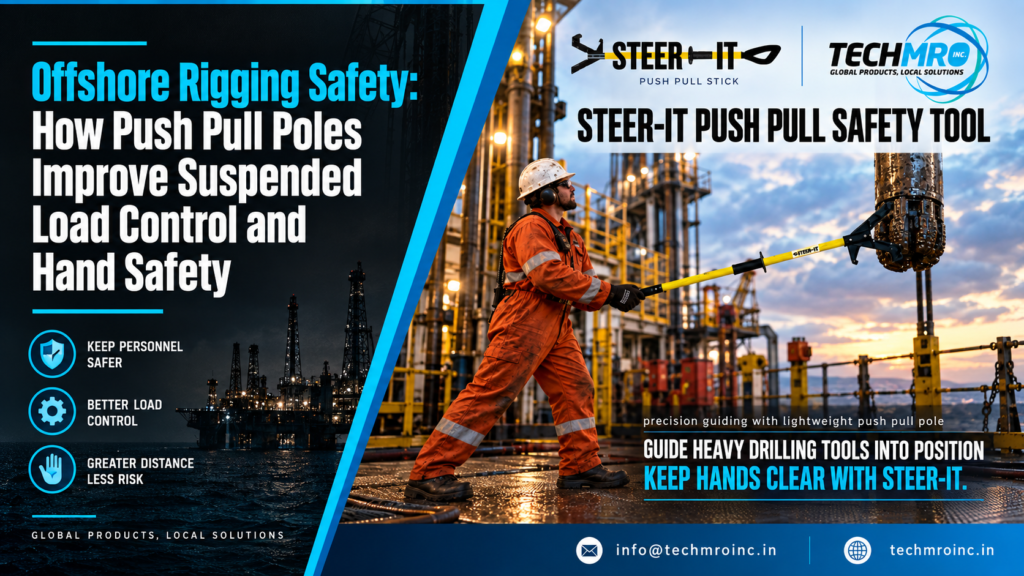
Offshore lifting does not end when a crane picks up a load. Some of the highest-risk moments can occur while the load is being guided, rotated, aligned, lowered or positioned.
For offshore operations across Africa, these activities create an important offshore rigging safety challenge: how can crews maintain effective control of suspended loads without placing their hands close to pinch points, crush zones or other hazardous movement areas?
A push pull pole provides a practical hands-free approach. Instead of reaching directly toward a suspended or shifting load, riggers can use an extended-reach tool to help push, pull, guide and position the load while maintaining greater separation from the immediate hazard area.
The Steer-it Push Pull Safety Tool is designed specifically for this purpose—helping offshore, marine and industrial crews improve suspended-load control while reducing unnecessary direct hand contact.
Why Offshore Rigging Safety in Africa Requires Better Load Control
Offshore oil and gas platforms, drilling rigs, marine terminals, fabrication yards, shipyards and support bases across Africa regularly handle heavy equipment.
Typical activities include crane lifts, deck cargo movement, tubular handling, machinery positioning, pipe handling, equipment maintenance and material transfer.
During these operations, the load may need small corrections before it can be safely landed. A suspended load can:
- swing or rotate;
- move unexpectedly during lowering;
- shift as rigging tension changes;
- drift toward structures;
- create narrowing gaps during landing; or
- require precise final positioning.
The instinctive response can be to reach toward the load and make a manual correction. That is where hand exposure increases.
IOGP's lifting and hoisting guidance emphasizes lift planning, hazard identification, clear responsibility, effective communication and keeping personnel clear of overhead loads and potential impact areas.
Can the load be controlled without putting a worker's hands directly on it?
The Hand-Safety Problem During Suspended Load Handling
Hands are often exposed during the final stage of lifting rather than during the main vertical movement.
Consider a load being lowered onto a deck. The crane has already moved most of the distance. The load is now close to its landing point, but it is slightly misaligned. A worker may be tempted to push it sideways with a hand.
If the load suddenly shifts, the space between the load and a fixed structure can disappear immediately.
The same problem can occur while positioning:
- pipes and tubulars;
- equipment skids;
- valves;
- machinery;
- containers;
- fabricated structures;
- maintenance components; or
- offshore deck equipment.
The issue is not simply the weight of the load. It is the combination of movement, limited clearance and worker proximity.
Pinch Points, Crush Zones and Line-of-Fire Exposure
Pinch Points
A hand can become trapped between a moving load and another surface. Examples include a pipe approaching a rack, equipment being positioned beside structural steel or a load being landed onto a foundation. Even a small final movement can create a severe pinch point.
Crush Zones
Heavy equipment does not need to travel far to create crushing force. When personnel stand close to a suspended load for final alignment, the distance between safe positioning and dangerous contact can become very small.
Line-of-Fire Hazards
A worker enters the line of fire when positioned where a moving, swinging, shifting or rotating object could travel. The entire body does not have to be exposed. A hand placed near the load can already be inside the hazardous movement path.
This is why hands-free load handling is increasingly relevant to modern rigging practices.
What Is a Push Pull Pole?
A push pull pole is an extended-reach industrial hand safety tool used to help workers control or position an object without placing their hands directly on the object.
Depending on the task, a push pull pole can assist with:
- pushing;
- pulling;
- steering;
- guiding;
- alignment; and
- final positioning.
Its purpose is not to lift the suspended load. Its purpose is to give the worker a means of influencing the load's direction while keeping greater distance between the hands and the immediate hazard zone.
For offshore lifting operations, this makes the push pull pole particularly relevant during final positioning and landing.
Steer-it Push Pull Safety Tool: A Hands-Free Load-Control Solution
Steer-it Push Pull Safety Tool by TechMRO Inc.
Steer-it is an industrial hands-free tool designed for guiding, maneuvering and positioning suspended or difficult-to-reach loads. It allows personnel to interact with a load through an extended tool instead of relying on direct hand contact.
How Steer-it Supports Offshore Rigging Safety
The main safety principle behind Steer-it is simple:
Increase the distance between the worker's hands and the hazard.
During a conventional manual correction, the worker's hand becomes the point of contact with the load. With a push pull pole, the tool becomes the point of contact.
That additional separation can help reduce unnecessary exposure when workers are guiding or positioning loads around potential pinch, crush or impact zones.
This does not remove the hazard created by the suspended load. Instead, it changes how the worker interacts with the hazard.
Offshore Applications for Push Pull Poles
Rig Floor Operations
Rig floors can involve tubulars, tools and equipment moving through relatively congested working areas. During positioning tasks, workers may need to influence the movement of an object without placing their hands near surrounding equipment. A push pull pole provides an extended method of guiding the object while maintaining separation.
Pipe and Tubular Positioning
Pipes and tubulars can roll, rotate or shift during handling. They may also create narrow gaps between the pipe and rack, deck or adjacent equipment. Steer-it is specifically presented for pipe positioning and guiding suspended loads on rig floors and fabrication yards.
Offshore Deck Lifting
Deck operations routinely involve baskets, containers, equipment, tools, pipe sections and maintenance materials. During final landing, a load may require a small directional correction. Where allowed by the lift plan and task risk assessment, a push pull pole can help the rigger make controlled adjustments without reaching directly toward the load.
Supply and Marine Operations
Offshore supply and marine operations can involve limited deck space, environmental movement and frequent cargo handling. Loads being transferred or positioned may need controlled guidance. A hands-free load-control tool can provide another option for maintaining separation during suitable positioning tasks.
Fabrication and Maintenance
Fabrication yards and offshore maintenance teams frequently position valves, pipe sections, fabricated components, machinery parts, structural items and mechanical equipment. Many of these tasks involve a final alignment stage where hand exposure can increase.
Application Reference Table
| Operation | Typical Exposure | Hands-Free Control Need | Steer-it Relevance |
|---|---|---|---|
| Rig-floor tubular positioning | Rolling, rotation, pinch zones | Guide or reposition without direct hand contact | Extended-reach pushing and guiding |
| Offshore deck load landing | Swing, final alignment, fixed structures | Small directional corrections from greater separation | Push/pull load positioning |
| Pipe handling | Narrow gaps, rotation, rack contact | Keep hands away from developing pinch points | Hands-free pipe positioning support |
| Supply and marine cargo handling | Movement, limited deck space, cargo transfer | Controlled guidance from a better working position | Extended-reach load interaction |
| Fabrication and maintenance lifts | Final alignment near structures or machinery | Reduce last-second manual corrections | Guiding and positioning support |
Why Distance Matters During Final Load Positioning
Offshore hand injuries can occur when people get close to equipment because they believe only a small adjustment remains. But the final few centimetres of movement can still contain considerable energy.
A load that rotates slightly can trap fingers. A pipe that rolls can close a gap. Equipment being lowered can move toward a fixed structure.
Where practical, the better approach is to reduce the need for the hand to enter that space at all. That is the core principle behind handsfree safety tools.
Push Pull Pole vs Direct Hand Contact
Direct manual load positioning puts the worker's hand at or near the movement point. A push pull pole creates additional reach between the worker and that point.
The load remains hazardous. The important difference is that the hand does not need to be the point where the worker applies directional control.
A Push Pull Pole Is Not a Lifting Device
A push pull safety tool should never be confused with certified lifting or rigging equipment. Its role is directional control and positioning.
The load itself must remain properly supported and controlled by suitable lifting equipment such as cranes, hoists, slings or other approved systems.
Steer-it should therefore complement—not replace—lift planning, certified rigging equipment, competent lifting personnel, banksmen or signalers, communication procedures, exclusion zones and task-specific risk assessments.
How can the worker guide or position the load while reducing unnecessary direct hand contact?
Does a Push Pull Pole Replace a Tagline?
Not necessarily. A tagline and a push pull pole perform different functions.
Taglines can provide load control from a distance in suitable lifting operations, while a push pull pole can provide direct extended-reach interaction for pushing, pulling, guiding or positioning.
Some lifting tasks may call for a tagline. Others may be more suitable for a push pull safety tool. Some may require another engineered control entirely.
The correct method should always be determined through the lift plan, risk assessment and applicable site procedures.
Building Hands-Free Load Control Into Offshore Operations
The most effective use of an industrial hand safety tool begins before the load moves.
During lift planning, teams should consider where the load could swing, rotate or shift; where pinch and crush points will develop; where workers will stand; how final alignment will be performed; and whether direct hand contact can be eliminated.
Instead of asking: “Where should the worker put their hands?”
Ask: “Why do the worker's hands need to be there at all?”
That is a stronger foundation for hands-free load handling.
Why Steer-it Is Relevant to African Offshore Operations
African offshore operations involve a wide range of lifting, rigging, maintenance and material-handling activities.
These environments can include offshore platforms, drilling rigs, marine support facilities, fabrication yards, shipyards, oilfield service bases and heavy industrial maintenance operations.
Across these activities, one recurring problem remains the same: workers may need to control or position heavy objects without placing their hands near hazardous movement.
The Steer-it Push Pull Safety Tool provides a practical hands-free method for addressing that problem.
Its extended reach, fiberglass construction, D-handle, hand guard and multiple length options allow teams to select a tool suited to different positioning requirements.
Frequently Asked Questions
- What is a push pull pole used for in offshore rigging?
- It is used to help push, pull, guide, steer or position suitable loads from an extended distance so the worker does not need to rely on direct hand contact at the movement point.
- Does a push pull pole lift the suspended load?
- No. A push pull pole is a directional-control and positioning tool. The load must remain supported by the appropriate certified lifting and rigging system.
- How does Steer-it support hand safety?
- Steer-it creates additional reach between the user's hands and the load, allowing suitable guiding and positioning tasks to be performed without making the hand the direct point of contact.
- Can Steer-it be used around pipes and tubulars?
- The supplied product content identifies pipe positioning, rig-floor operations and fabrication-yard suspended-load guiding among its relevant applications.
- Does a push pull pole replace a tagline?
- Not automatically. The two methods perform different load-control functions. The appropriate method should be selected through the lift plan, risk assessment and site procedures.
From Hand Safety Awareness to Hands-Free Control
Traditional safety messages often focus on awareness: watch your hands, recognise pinch points and stay out of the line of fire.
Those instructions remain important. But offshore rigging safety can go further.
If an operation can reduce the need for a worker to place their hands near the load in the first place, the safety strategy moves from simply recognising the hazard toward reducing exposure to it.
That is where a push pull pole becomes valuable.
The objective is not merely to move the load. It is to help workers maintain control without unnecessarily putting their hands where the load can pinch, crush or strike them.
For offshore oil and gas, marine, shipyard, fabrication and heavy industrial operations across Africa, the Steer-it Push Pull Safety Tool offers a practical approach to hands-free suspended-load guiding and positioning.
Improve Offshore Rigging Safety with Steer-it
Reduce unnecessary direct hand contact during suitable suspended-load guiding and positioning tasks. Use the Steer-it Push Pull Safety Tool to extend reach, improve directional control and support hands-free load handling during offshore and industrial operations.
Explore Steer-it at PushPullTools.comControl the load. Create distance. Keep hands away from the hazard zone.
SEO Reference
Title Tag
Offshore Rigging Safety in Africa | Push Pull Pole Guide
Meta Description
Improve offshore rigging safety in Africa with push pull poles for hands-free suspended load control, safer positioning and reduced hand exposure.
URL Slug
/offshore-rigging-safety-push-pull-pole-africa/
Primary & Supporting Keywords
- offshore rigging safety
- push pull pole
- suspended load control tools
- handsfree safety tools
- industrial hand safety tools
- hands free load handling
- offshore hand safety
- pinch point prevention
- line of fire safety
Suggested Image Alt Text
Steer-it push pull pole for offshore rigging safety and suspended load control in AfricaHands-free push pull safety tool guiding suspended load on offshore deckSteer-it industrial hand safety tool for pipe and tubular positioningPush pull pole used for hands-free load positioning during offshore lifting