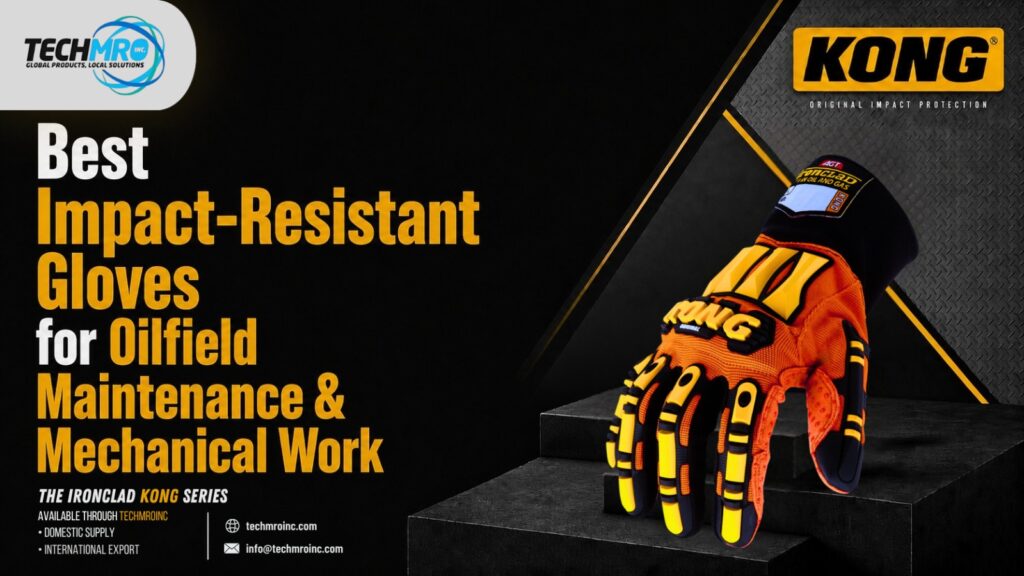
KONG Glove India: Best Impact-Resistant Gloves for Oilfield Maintenance & Mechanical Work
Available Through TechMROInc • Domestic Supply • International Export
What safety professionals and procurement teams need to know when specifying hand protection for demanding maintenance environments.
Why Hand Protection Is Critical in Oilfield Maintenance
Oilfield maintenance is one of the most demanding activities in the energy sector. Unlike drilling operations that focus on a specific set of tasks, maintenance teams encounter a wide variety of equipment, tools, components, and working conditions every single day.
From servicing pumps and valves to repairing compressors, changing components, tightening connections, and handling heavy equipment — maintenance personnel rely heavily on their hands. This makes hand protection a critical part of oilfield operations.
Selecting the right glove is not always straightforward. A glove that works well for one task may be unsuitable for another. Safety managers and procurement teams must balance protection, durability, comfort, and performance to ensure workers are adequately equipped.
Common Hand Hazards During Oilfield Maintenance
Maintenance personnel move between different work areas throughout a shift, exposing them to multiple hand hazards rather than a single risk type. This breadth is what makes glove selection particularly important.
Impact
Wrenches, power tools, heavy components, and mechanical parts can cause knuckle, finger, and back-of-hand injuries.
Abrasion
Prolonged contact with equipment housings, metal structures, fasteners, and industrial components causes skin wear over time.
Grip Loss
Oil, grease, hydraulic fluids, and water reduce grip on tools and components, increasing risk of dropped loads and slippage.
Fatigue
Repetitive tasks across extended shifts reduce hand performance. Poor glove design accelerates fatigue and reduces compliance.
What Safety Managers Should Look For
Specifying gloves for maintenance work requires evaluating five key performance factors simultaneously. A glove that excels in only one dimension is rarely the right answer for oilfield environments.
Impact Protection
Back-of-hand protection that reduces injury severity from tool and equipment contact during routine tasks.
Durability
Construction that withstands daily tool handling, mechanical work, and equipment servicing without premature breakdown.
Grip Performance
Reliable grip in environments involving oil, grease, water, and industrial contaminants — without sacrificing dexterity.
Dexterity
Precision control for tightening bolts, adjusting fittings, working with hand tools, and equipment troubleshooting.
Comfort for Extended Wear
Comfort over a full shift influences worker acceptance, compliance, and ultimately whether the glove actually gets worn. A glove that stays in the pocket provides zero protection.
Why Standard Work Gloves Fall Short
Many organizations still rely on basic work gloves for maintenance activities. While these provide general coverage, they frequently underperform in demanding oilfield environments across several key dimensions:
- Limited or no impact protection
- Reduced durability under daily wear
- Poor grip performance in contaminated environments
- Short service life leading to frequent replacement
- Inadequate support for heavy-duty mechanical applications
As maintenance operations become more complex, leading safety teams are moving toward gloves specifically engineered for industrial environments — with certifiable protection standards rather than general-purpose claims.
KONG Original SDX2 — Built for Demanding Maintenance Environments
Widely specified in oil & gas, mining, and industrial manufacturing across demanding global operations.
Advanced back-of-hand protection engineered to reduce injury severity from tool impacts, equipment contact, and material handling incidents.
Built to withstand constant stress from tool use, equipment servicing, and heavy-duty mechanical applications without degrading.
Grip performance maintained across oil, grease, water, and industrial contaminant exposure — conditions routine to oilfield maintenance.
Construction designed for the daily demands of industrial maintenance environments, reducing replacement frequency and total cost of ownership.
Industry Applications
The KONG Original SDX2 is specified across multiple sectors where workers face impact hazards, demanding workloads, and challenging operating conditions.
Frequently Asked Questions
What gloves are commonly used for oilfield maintenance?
Many maintenance teams specify impact-resistant gloves designed for mechanical work and industrial applications, with certifiable ANSI impact ratings rather than general-purpose hand protection.
Why are impact gloves important for maintenance work?
Maintenance personnel frequently handle tools, equipment, and components that create high-energy impact risks — particularly at the knuckles and back of hand. Impact-rated gloves reduce injury severity in these events.
What should safety managers prioritize in maintenance gloves?
Impact protection, durability, grip performance, comfort for extended wear, and sufficient dexterity for precision tasks are the five non-negotiable criteria for oilfield maintenance applications.
Is the KONG Original SDX2 suitable for mechanical work?
Yes. The SDX2 is widely specified in maintenance and industrial environments globally where ANSI Impact Level 2 protection is required alongside reliable grip and durability.
Which industries use impact-resistant maintenance gloves?
Oil & gas, manufacturing, construction, mining, offshore, and industrial maintenance operations — any environment where hands interact regularly with heavy equipment and tools.
Sourcing Industrial Gloves for Your Operation?
TechMROInc is an authorized distributor of KONG industrial gloves in India, supplying oil & gas, drilling, manufacturing, mining, and offshore sectors.